
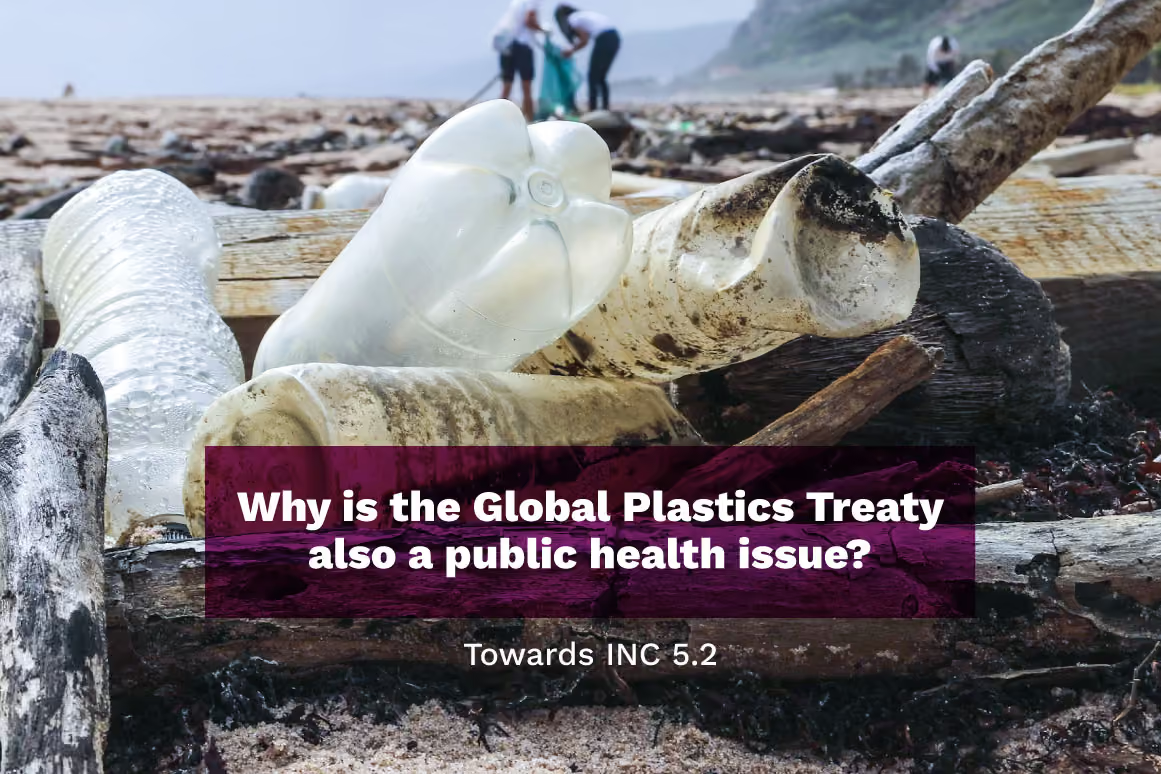
Why is the Global Plastics Treaty also a public health issue?
If you still don't know what the Global Plastics Treaty is about, this legal instrument that could change the course of plastic production, consumption, management and pollution worldwide, we recommend This reading initial.
What is at stake
Right now, in July 2025, we are on the verge of the sixth round of negotiations of the Intergovernmental Negotiating Committee (INC), which seeks to achieve the signing of an ambitious and binding global treaty for the countries that make up the United Nations, with the objective of addressing the global plastic crisis, from its production to its final disposal, with a comprehensive approach that also prioritizes public health.
INC 5.2 will take place between August 5 and 14, 2025, in Geneva, Switzerland. This international negotiation is a crucial opportunity to conclude the meetings and agree on the final text containing the rules that the signatory countries, including Ecuador, must comply with in order to achieve a powerful treaty that achieves significant global changes. It is worth noting that Ecuador is part of the Coalition of High Ambition Countries (countries that came together to push for ambitious rules for the treaty).
Geovana Polo, Strategic Development Manager at ReciVeci, participated during the month of June 2025 in the event of National Consultation on the Treaty in Ecuador, organized by the Institute of Applied Ecology, Univ. From San Francisco de Quito, WWF Ecuador and Plastico Project, with the purpose of preparing related professionals for INC 5.2. Also there were Ambassador Luis Vayas, president of the Intergovernmental Negotiating Committee, and Walter Schulz, Ecuador's chief negotiator for the Treaty. Based on this experience, we wrote this publication to bring our community closer to a topic that, although technical, is key to understanding the future of plastic in Ecuador and the world.
The complexity of negotiating a draft Treaty, full of square brackets
After 5 rounds of negotiation, the draft text of the Global Plastics Treaty continues to hold points without consensus of the parties, which are identified with square brackets. Currently, in a single paragraph, there can be up to 20 square brackets. This reflects the complexity of agreeing on such sensitive issues as production, chemicals of concern and funding mechanisms for the global implementation of the treaty.
One of the biggest challenges is that the approval of the treaty must be unanimous among the more than 175 participating countries: a simple majority or a qualified majority is not enough, they must reach a consensus. This makes the process slow and complex, but it also ensures that the treaty has binding force for all signatory countries.
For this INC 5.2, they will focus on three main axes: production, chemicals of concern and funding mechanisms.
- Production: attacking the problem at its root
“Every plastic molecule ever created still exists somewhere on Earth.” — Documentary Plastic People (White Pine Pictures).
Plastic production is the starting point for any real solution. Today there are more than 430 million metric tons of plastic in a year, and 2/3 of the plastics produced are discarded after a single use (United Nations Environment Program, 2024).
To control pollution, the entire life cycle of plastic must be analyzed: rationalize its manufacture and use of raw materials, increase the number of recycled materials and reduce its consumption. If we cannot act with force in production, everything else - reduction, recycling, reuse - will be insufficient.
This is a sensitive point because some countries and sectors are not willing to commit to a significant reduction in production, due to economic and market interests.
- Chemicals of concern in plastics: an invisible risk to our health.
The topic of chemicals in plastics could be enough for an entire blog, but the essential thing is to understand that 1) we are just beginning to discover the amount of chemicals that exist in plastics and their possible negative effects on our bodies and on the earth, and 2) that this represents a real public health problem.
“The risk assessment for plastics is based on information about the use of a plastic product and its chemical composition. Information is required on migration (i.e., the transfer of a chemical from plastic to food, air, water, or other environmental media) and on exposure levels (in humans or in the environment).” - Source: European Chemicals Agency (ECHA).
According to figures from PlastChem, There are at least 16,000 known plastic chemicals that are potentially used or are present in plastics, making plastics a difficult chemical bomb to defuse. More than 4,200 chemicals in plastics (25%) are hazardous to human health or the environment. In the midst of this alarming context, only 6% of all plastic chemicals are internationally regulated, and there are additional national regulations that apply to 1,000 chemicals.
Many of these substances are endocrine disruptors or have toxic effects that affect neurological development and other vital processes:
”It is estimated that in 2012, 1.3 million lives and 43 million years of life adjusted for disability (DALYs), a measure of the burden of disease, were lost due to exposure to certain chemicals, including sources other than plastics (World Health Organization, 2016)” - Source: European Chemicals Agency (ECHA).
The Treaty seeks to make countries responsible for identifying and progressively eliminating the use of these dangerous chemicals, but there is debate about what substances will be eliminated, in what time frames and under what conditions. In addition, there are concerns about the economic impact this may have on some industries.
- Funding mechanisms: a pillar for a just transition
Financing mechanisms are processes agreed upon by countries to secure economic resources, funds and technical support to implement the measures established in the Treaty throughout the life cycle of plastics. These mechanisms must be differentiated, since not all countries have the same social and economic conditions, and it is essential that they consider clear and effective ways to mobilize resources to those who need them most.
For countries in the Global South, such as Ecuador, having solid financing mechanisms is key to achieving the transition to sustainable production, consumption and management of plastics. This involves ensuring that resources—financial and technical—reach producers, recyclers and affected communities fairly and directly, strengthening capacities and actions in the territory.
What can we expect from the INC 5.2 round?
One of those in this round is to advance the definition of priority plastics for regulation, such as single-use plastics and those with a short lifespan, whose impacts are urgent (e.g. food tubs, plastic bottles, disposable cutlery, etc.). It is expected to establish an initial list to work on gradually, but urgently.
Although many are unaware of the existence and relevance of this treaty, for those of us in the environmental and social sector, the urgency is clear and it proposes an increasingly inevitable change in the reduction of plastics, for which we must prepare as a society.
Let's remember the important and non-negotiable points of the Global Plastics Treaty:
- It has to be legally binding for all member countries (if it's voluntary, it doesn't work for us).
- You have to look after one Just Transition to ensure that the vulnerable groups involved in this process (communities, plastic industry workers, grassroots recyclers, and others) are taken into account on the path to reducing plastic pollution.
- It must emphasize the recognition of the work of basic waste pickers present all over the world.
The role of ReciVeci: part of the solution to a just transition
At ReciVeci we are aware that, although the ultimate objective of the treaty is to combat plastic pollution, by reducing consumption and eventually eliminating the production of certain types of plastic, this process will take time. While this is happening, basic recyclers are essential since they recover tons of plastic that are reinserted into production processes, generating circularity. Waste pickers are the protagonists of the just transition and for this reason they have played a leading role in the INC negotiations, promoting their inclusion in the text of the treaty.
For this reason, the various processes that we promote at ReciVeci, related to the recognition by the community and companies of basic waste pickers, the payment for Just a ton, the improvement of their capacity to recover materials, and therefore the improvement of their quality of life; these are significant actions at this crucial moment that the entire planet and our country are going through.
We highlight that ReciVeci and Mingas por el Mar are leading the consultancy that is developing the National Plan for the Reduction of Plastic Waste (PNRRP), which is promoted by WWF Ecuador and the Ministry of Water, Environment and Ecological Transition (MAATE). In addition, we are part of the international plastics action platform GPAP and the national NPAP platform, and recently from the Coalition “Business Coalition for Plastic Treaty”, which allows us to contribute to the country's public policy, demonstrating our vision and vocation to move towards a fairer world with fewer plastics.
It's not just about regulating plastic molecules, but about building a different future for millions of people, ecosystems and for the entire planet. Remember that negotiations for the Global Plastics Treaty continue in the month of August 2025, and July without Plastics it's the perfect opportunity to join the change from home. Get informed, share what you learn and see how you can reduce, reuse and recycle plastics every day. Every action counts to achieve a future free of plastic pollution!
Consulted links:
- PlastChem Project: PlastChem. (s.f.). Findings. PlastChem Project.
- The circular economy for plastics: European Human Biomonitoring Initiative.
- Global Plastics Treaty: An Instrument to Change the Course of Global Plastic Production and Pollution


