
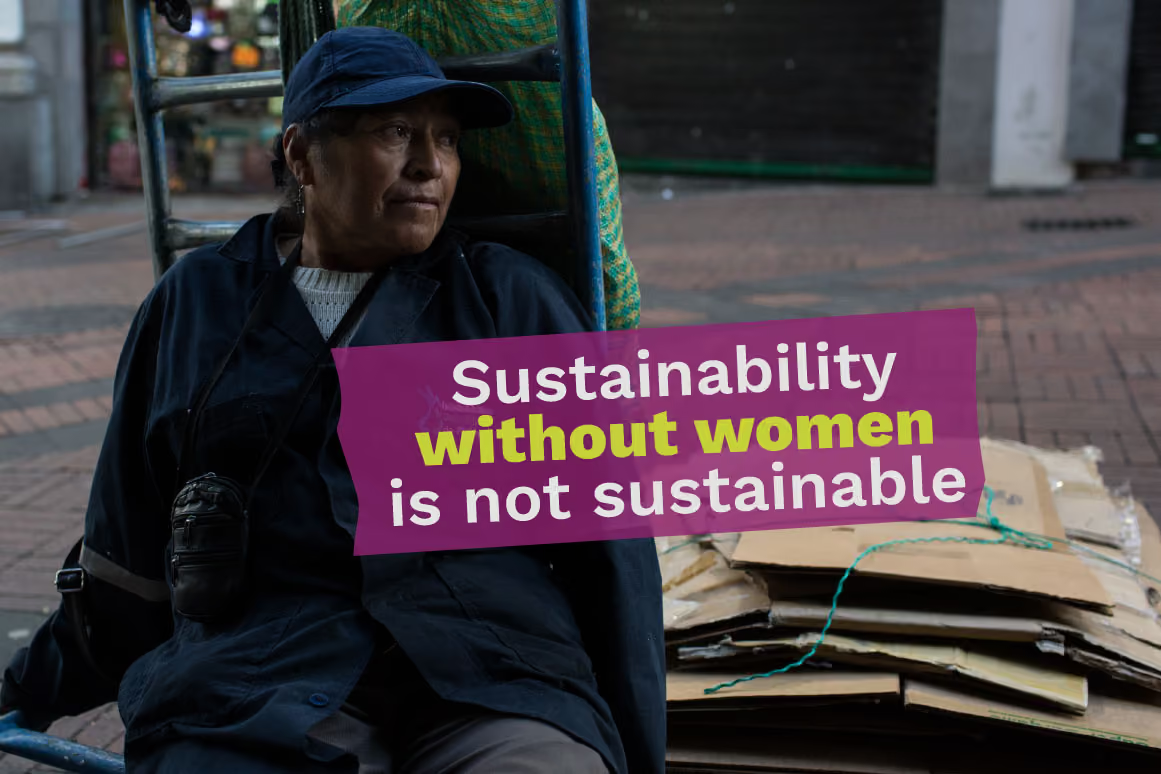
Every March 8, we talk about the barriers women face in their jobs or about the violence that still persists in society. But there is a gap that silently cuts through the environmental debate. The one about care.
In Latin America, women do 75% of household chores that are not paid, According to the ECLAC. This includes cleaning, cooking, separating waste and maintaining order. In practice, the circular economy depends on these hands. It is not an automatic machine process, but it is sustained because thousands of women sort and recover materials in their homes and on the streets.
When we look at recycling with this lens, we see that it's not just a waste issue. It is a conversation about the right to decent work and the recognition of those who maintain the cleanliness of our cities.
The women who drive recycling in the region
More than 3.8 million people in our region live by recovering recyclable materials. In many countries, such as Ecuador, women represent between half and 70% of this group. Many are mothers and heads of household and recycling allows them to work without bosses and with flexible schedules to be able to care for their children or older family members.
However, that flexibility also reveals a more complex reality.
The possibility of working without rigid schedules is often due to the fact that women are still the ones who assume most of the care work within homes. Between recycling routes, parenting, cooking and household chores, time for rest, health or personal well-being is often left behind. In practice, many waste pickers end up supporting both the care economy and the circular economy, sacrificing their own time to make both work.
Working together with grassroots recyclers, we have also seen how these inequalities are reproduced within the recycling chain itself. In some cases, women do much of the work of retrieving and sorting materials, but negotiations or payments within the system end up going through male middlemen. They are dynamics that reflect historical power relationships over who controls revenues and who is left in the most vulnerable positions within the value chain.
What we sometimes see as “informal” work is actually a survival strategy in the face of the lack of stable employment and inclusive public policies. When this work is not recognized or adequately remunerated, what gender specialists call economic violence occurs, a form of structural inequality that limits women's autonomy and their access to decent income. Therefore, talking about inclusive recycling is not just talking about waste or environmental sustainability. It is also talking about economic justice and recognizing the historic work of those who have maintained the cleanliness of our cities.
What we can learn from the region
In Latin America, there are experiences that show how recycling can be transformed when the work of those who support it is recognized. Some of these cases have been documented by the regional initiative Connecting the Circle, powered by the GIZ GADER-ALC network.
In Brazil waste pickers (called waste pickers) understood that unity is strength. Through the ANCAT organization, they managed to pass a national law in 2010 that recognizes their work as an essential part of the country's waste management. The most important thing is that today women not only collect bottles, but they also lead cooperatives and sit down to negotiate contracts directly with municipalities.
In Colombia the change came hand in hand with justice. The ex officio recyclers (recyclers based in Ecuador) were able to get the Court to recognize them as providing a public service just like the garbage truck. This changed everything because they now receive a more stable payment and access to social security. For them, this means having their own money and not being financially dependent on anyone in their household.
These experiences show something important. When waste pickers have organization, training and institutional support, the circular economy works better.
The impact of ReciVeci in Ecuador
The main beneficiaries are basic waste pickers, many female heads of household and young women responsible for family care. The model recognizes that recycling is linked to its role of care.
ReciVeci regularly trains basic waste pickers on various topics that contribute to improving their work and quality of life. These trainings include, among other areas:
- Sexual and reproductive health
- Personal finance
- Leadership
- Associativity
- Safety and use of protective equipment
This is a gender approach applied to the circular economy. Not only improving productivity, but strengthening autonomy.
Role transformation
Another example is the Glass Hub of ReciVeci®, opened in 2023. Four operators, three of them women, work in this space, carrying out tasks such as sorting, handling and storing recovered glass.
The presence of women in these tasks is significant because it involves handling large volumes of heavy material, an activity historically associated with men within the sector.
During the year 2025, the management of ReciVeci® recovered 1,050 tons of recyclable materials, considering both the work of the Glass Hub and other system operations. An important part of this recovery is achieved thanks to the 19 active recycling stations in Quito, all managed by grassroots recyclers. They also receive direct payment for the collection service, which guarantees better income for their households and professionalizes work that was historically invisible.
My engagement is on March 8th
If you believe in a sustainable world, it's time to bet on women's leadership. At ReciVeci we have the tools ready for your intention to turn into an action with real impact.
You can separate your waste at home and deliver it to a basic recycler through ReciApp®, take it to our 19 recycling stations managed by women or hire our collection services for companies with a social impact.
This March 8, remember that when a woman recycles, she does not only recover plastic or glass. He is regaining his courage before society and power over his own life.


