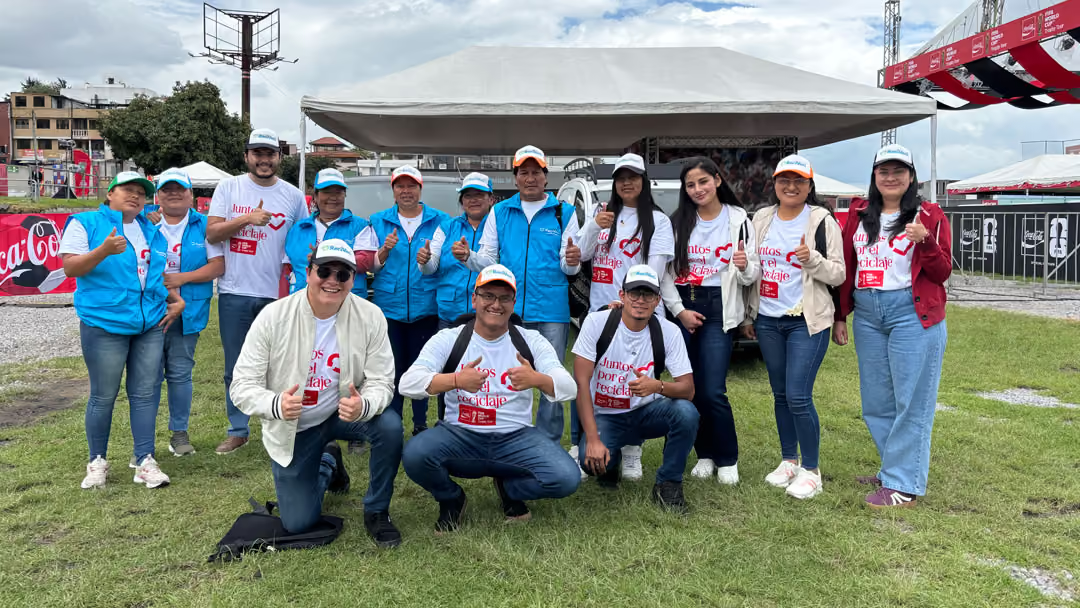
While thousands of people lined up to see the most important trophy in world football up close, a team of grassroots recyclers and recyclers worked to ensure that the celebration did not leave a negative environmental footprint in Quito.
On February 17, 2026, the 2026 FIFA World Cup Trophy Tour, presented by Coca-Cola, arrived at the Quorum of Paseo San Francisco and brought together more than 4,000 fans who had the experience of seeing the original trophy. Music, brand activations, food and t-shirts from the national team marked the day.
In the midst of that soccer party, ReciVeci® activated its ReciEventos® service to manage the recyclable waste generated during the match. The objective was to demonstrate that a massive event can also be a space for circular economy and decent work.
A team of 12 waste pickers and educational promoters toured the entire venue throughout the event. They did not just wait at fixed points, but they walked among the people, talked with attendees and promoted the correct separation of waste. “Can you help us with your empty bottles? This is how we make sure that this is recycled”, was one of the most repeated phrases throughout the day.
.avif)
The strategy combined real-time environmental education with direct recovery of recyclable materials, mainly plastic bottles. In events of this magnitude, these materials are usually mixed with other wastes and end up in final disposition. This time, the approach was different.
Each material collected was separated and recorded to ensure traceability. Since the event, the waste was transferred to the collection center, where it is classified by type and quality before returning to the production chain as raw material. This process makes it possible not only to recover materials, but also to accurately measure the socio-environmental impact generated.
Through ReciEvents, ReciVeci® offers companies, universities, organizations and housing complexes a comprehensive service which includes the presence of basic recyclers during the event, the collection and transport of recovered recyclable waste and the sending of a statement of account with the positive impacts achieved. In addition, management is publicly communicated on social networks to make results transparent and to make the work of basic recycling visible.
During the Trophy Tour, hundreds of kilos of recyclable material were recovered, which prevented the emission of 300 kg of CO₂ eq. In addition, the collection and environmental education service generated direct income for the basic team of recyclers and recyclers. This component is fundamental, since the ReciVeci model prioritizes the generation of fair income and decent conditions, strengthening the circular economy with a social focus.
Beyond material recovery, the event was also a space for awareness-raising. Several people in attendance acknowledged that they had not thought about the destination of the waste generated in this type of celebration. Direct interaction with basic recyclers made it possible to connect the daily act of discarding a bottle with a value chain that impacts both the environment and the popular economy.

For the team, the day had a special meaning. Vero and Vanessa, soccer fans, were not only part of the environmental management of the event, but they were also able to get closer to the trophy thanks to Coca-Cola. The experience combined work, pride and celebration, and demonstrated that sustainability can be naturally integrated into the most exciting moments of the city's cultural and sporting agenda.
With this intervention, ReciVeci demonstrates that sustainability in events is not a decorative complement, but an operational decision that requires planning, human resources and commitment. Proper waste management can be integrated without affecting the attendees' experience and, at the same time, generate measurable environmental impacts and concrete social benefits.
Organizations interested in implementing a ReciEventos® can: contact ReciVeci® to design sustainable events that recover recyclable-returnable materials, measure their impact and contribute to a more responsible city with its waste.

